| |
FROM THE AUTHOR |
 |
Dear Reader,
I'm not sure what it is that compels
people to write stories, but I am convinced that writers are
born, not made.
We had two books in our home when I
was a child. One was a book on childhood illnesses, and the
second was an encyclopedia, L-N, given by the local grocery
store if you spent twenty dollars or more. I didn't care for
either book and had no idea that other kinds of books existed-fiction
books, books that could transport you into other times, other
lives, other minds. And though I had not yet learned to print
or spell, I still felt compelled to write. With no paper or
writing implements at my disposal, I carried sticks into my
room and scribbled on my unfinished walls. I was convinced
that hundreds of years later, some advanced beings would buy
the house, tear down the walls, and with eyes and minds advanced
far beyond ours, use their ability to see invisible ink and
to decipher the meaning soaked into a child's scribbles, to
read the stories and secrets I'd left there.
Years passed before I discovered the
magic of fiction, and even more years passed before I dared
to admit that I had a dream to become a published novelist.
Granted, there was nothing to prove to me that I could do
it if I tried. I'd always been a poor student, more involved
with my inner world than the facts written on the chalkboard.
I skipped college, married at seventeen, became a mother at
eighteen, and spent years living in an isolated town in the
northwoods of Wisconsin, population 249. What possibly made
me believe that I could one day prop my book alongside the
hundreds of books that now filled my book shelves? Nothing,
it seemed, but a resoluteness that said that if I practiced
long enough, and tried hard enough, I could dream my dream
true.
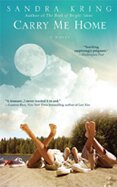
The night before I began Carry Me Home,
I was looking through the photographs my recently deceased
father had taken while serving in the Pacific during WWII.
The images of the dead soldiers strung across the battlefield,
as well as the images of my father standing with his arms
linked across the shoulders of two young men he had identified
simply as "my buddies," haunted me after I turned in that
night. At that time, it seemed likely that we were going to
war in Iraq, and as a mother of a teenage boy and an aunt
to draftable nephews,
|
| |
|
|


|
I felt anxious. What, I wondered, would
it be like to send your beloved son, husband, or boyfriend
off to war, and what would it be like for all of you once
they returned?
The next morning, I woke before dawn
with this question in mind and began writing. A mother, father,
and family hero who would go off to war emerged. Five minutes
later, the unlikely voice of Earl "Earwig" Gunderman spoke,
and one paragraph into the book, I knew that this was the
novel that would give me my dream.
People often ask me how I managed to
write from the point of view of a brain-damaged teenaged boy.
I'm not quite sure, except to say that when I strip away all
I know about human nature, psychology, and logic, Earwig's
questions about life, death, religion, war, prejudice, and
love are my own. I guess this is why I love writing so much.
It is my chance to wonder out loud.
So welcome to my world, oh intelligent
being. I hope you enjoy my scribblings.
My best,
Sandra
Kring
|
|